
Last updated November 2, 2026
 Wrought iron
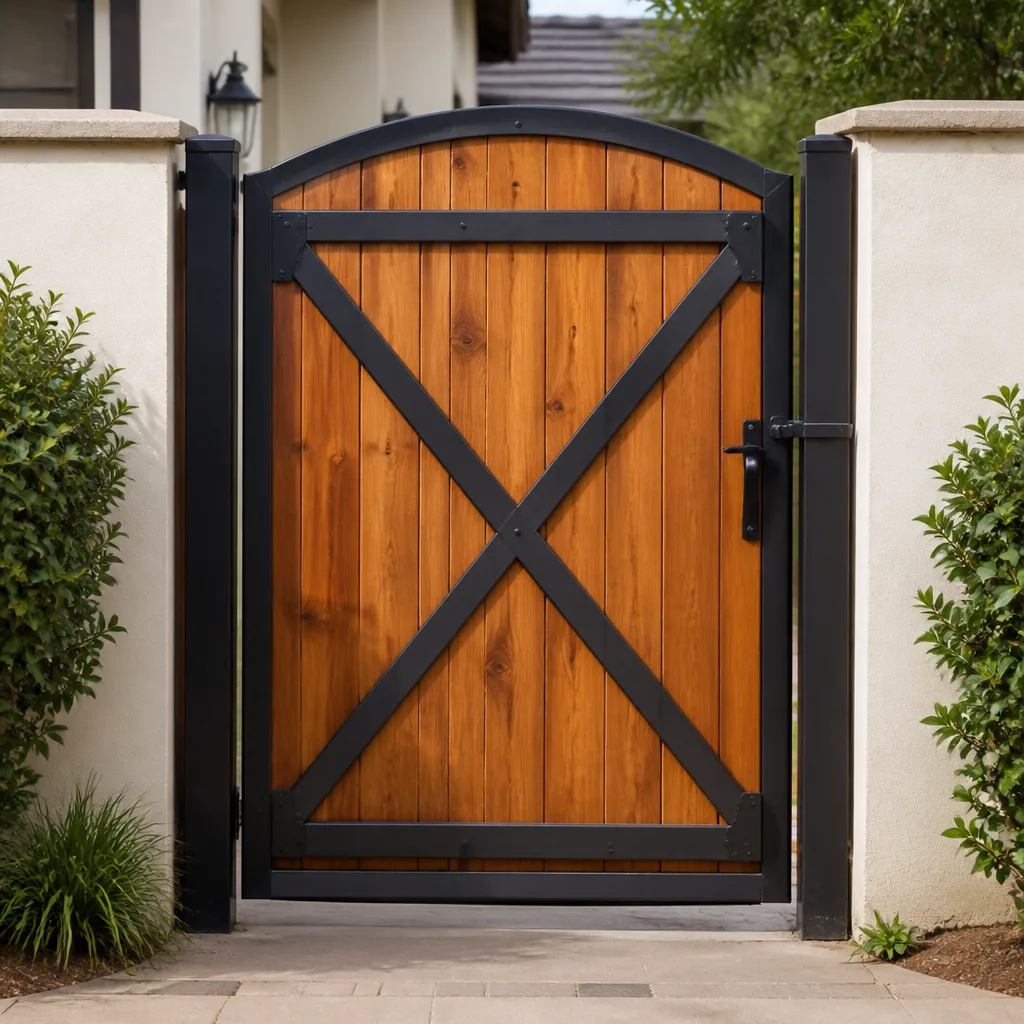 Wood & steel frame
 Farm & ranch
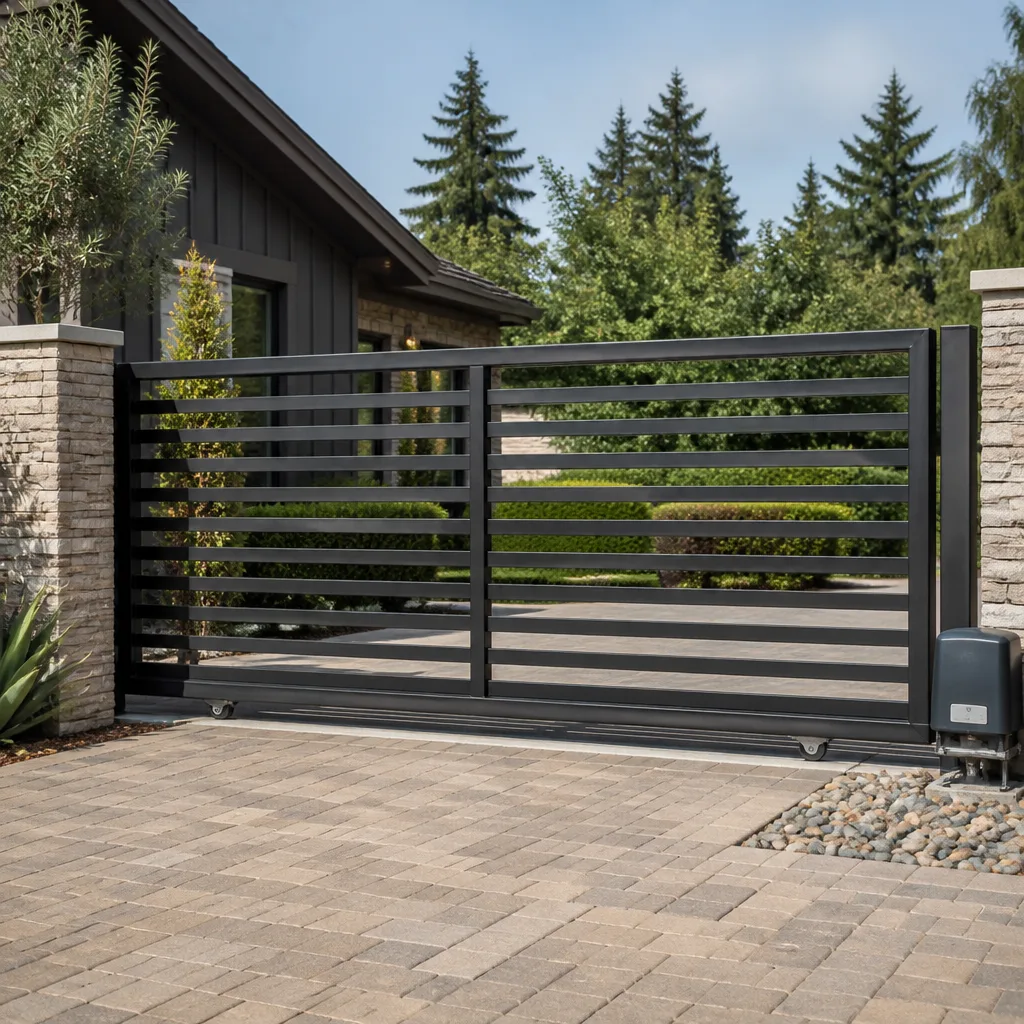 Sliding driveway gates
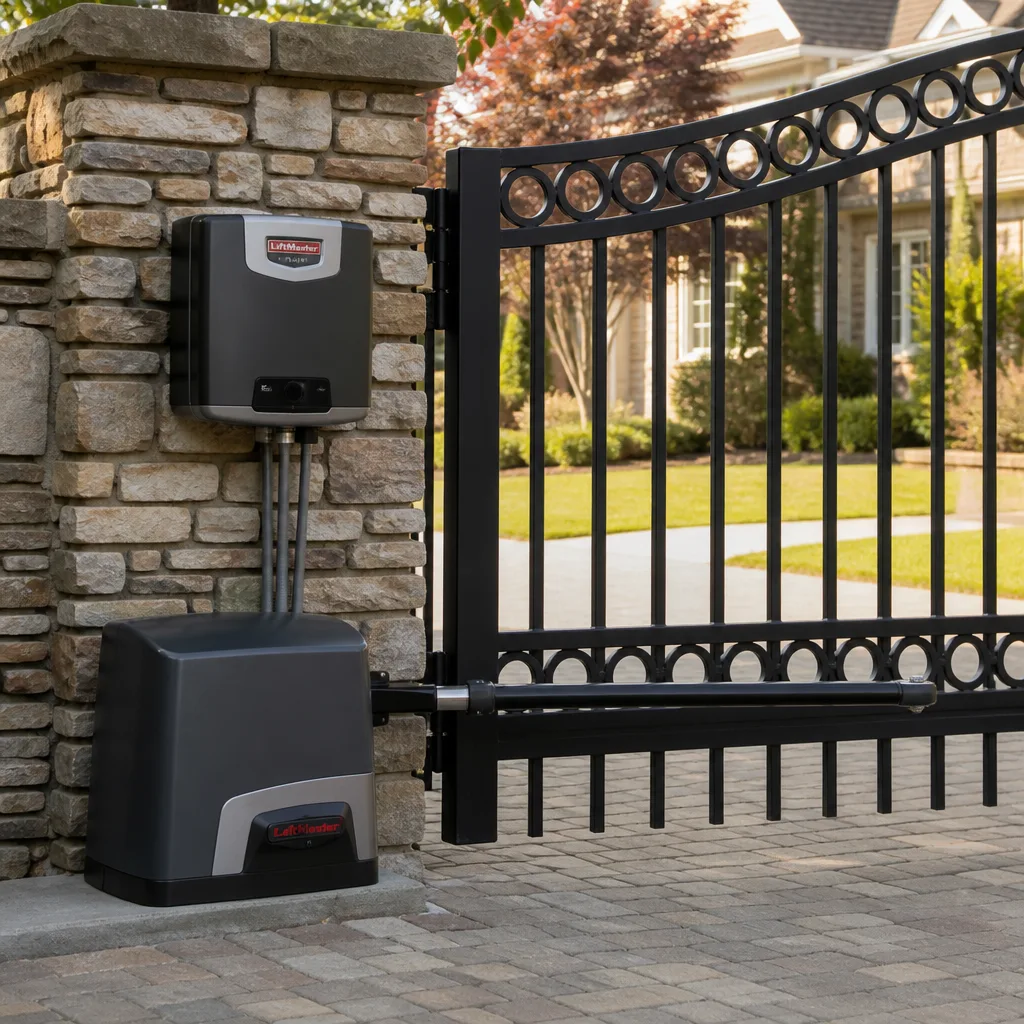 LiftMaster operators
Free on-site gate assessment - hinges, posts, and your LiftMaster or Nice gate operator checked before anything is quoted
The assessment is free and the quote is the invoice.
Get your free estimateGate Repair Emergency Preparedness Guide for San Carlos Homes
During the October 2019 PSPS outages, San Mateo County fire and police dispatch centers logged a quiet but telling spike: calls from homeowners trapped inside or locked outside their own properties because an automated gate had failed without grid power. The manual release mechanism that would have solved most of those calls in thirty seconds was something roughly six in ten gate owners had never located, let alone tested. This guide exists so you are not that person when the next outage, evacuation order, or medical emergency hits San Carlos, and our Gate Repair services are here when you need professional help. We will walk through exactly what to do when your gate fails at the worst possible moment, what to prepare beforehand, and which stopgap measures are safe to attempt while you wait for a technician.
Styles & brands we work with
- Wrought iron
- Wood & steel frame
- Farm & ranch
- Sliding driveway gates
- LiftMaster operators
Quick Answer
A gate emergency in San Carlos is manageable if you know three things before you need them: where your operator’s manual release is, how to operate it with no power, and whether your system has any battery backup at all. Prepare now by locating and testing your manual release, posting an emergency gate info sheet near your front door, and scheduling a pre-season inspection if your operator is more than five years old. For immediate gate failure, call Gate Repair San Carlos at (855) 395-1573 – we work on LiftMaster, FAAC, Mighty Mule, and Elite systems and diagnose first, replacing only what actually needs it. You can also explore our more guides & resources for ongoing maintenance tips.
Table of Contents
- Why San Carlos Gates Fail at the Worst Times
- Know Your Operator Before the Outage
- Manual Release Procedure for Five Common Operators
- What to Do When the Manual Release Is Jammed
- PSPS and Battery Backup: What Actually Works
- Evacuation-Specific Gate Protocol
- Emergency Stopgap Repairs You Can Safely Attempt
- The One-Page Emergency Gate Info Sheet
- Common Mistakes to Avoid
- When to Call a Professional
- Frequently Asked Questions
- The Bottom Line
Why San Carlos Gates Fail at the Worst Times
San Carlos has a specific combination of geography, climate, and infrastructure that makes automated gate failures more likely during emergencies than in flatter, cooler parts of the Bay Area. Homes in the hills above Alameda de las Pulgas – the Devonshire Canyon area, Crestview, and the neighborhoods climbing toward Eaton Park – sit on slopes where gate operators work harder against gravity on every cycle. A slide gate on an incline is constantly fighting the grade, which accelerates wear on the drive chain, the limit switches, and the motor brushes. In our experience across San Carlos service calls, hillside operators fail at roughly twice the rate of flat-lot installations.
Then there is the wind. Afternoon gusts coming through the gap near Sugarloaf Mountain and down the canyons put lateral stress on swing gates that most residential operators were never engineered to absorb. A wind gust catches a solid wood or wrought-iron gate leaf like a sail, and the operator arm takes the hit. Over years, that translates into bent arms, stripped gears in the opener, and hinge welds that slowly crack. When the next big wind event coincides with a PSPS outage, the failures compound: a gate that was already mechanically marginal loses its backup battery, and a stuck arm becomes a locked driveway.
Finally, San Carlos sits in PG&E’s PSPS territory. When wind speeds exceed thresholds and humidity drops, PG&E de-energizes transmission lines across the Peninsula as a fire-prevention measure. That is not an inconvenience; it is a planned, multi-day grid shutdown. An automated gate without battery backup becomes a dead gate on hour one of a three-day outage. And when a mandatory evacuation order follows, the gate becomes the difference between leaving on your schedule and leaving on the fire’s schedule.
Know Your Operator Before the Outage
Most San Carlos homes have one of five operator types controlling the driveway gate: LiftMaster swing or slide operators, FAAC hydraulic or electromechanical units, Mighty Mule swing openers (extremely common in the DIY and mid-range residential market), Elite slide gate operators (frequent on newer estate and hillside properties), or the occasional Viking or BFT commercial-grade unit on multi-home shared driveways. Each has a manual release designed differently, and each has its own failure mode when exposed to San Carlos conditions without maintenance.
The single most important preparation step is this: go to your operator right now, before any storm or outage, and physically locate the manual release. Following a thorough Gate Repair Maintenance Checklist for San Carlos Homeowners can help ensure nothing is overlooked. It is almost always a small red or yellow handle, a pull chain, or a keyed cylinder on the side or underside of the operator housing. If you cannot find it within two minutes, your gate is a liability. Write down exactly where it is. Test it once. Then put that information on the emergency sheet described later in this guide.
If you have no idea what brand your operator is, look at the motor housing for a nameplate. If the nameplate is faded or missing, check your remote controls or keypad. If those are unmarked too, take a photo of the operator from three angles and an Electric Gate Repair in San Carlos technician can identify it by the arm design, gear housing shape, or control board layout. We are trained across nine major gate brands, and identification is usually a ten-second visual check for us. It does not need to be a research project for you.
Manual Release Procedure for Five Common Operators
The manual release disengages the operator motor from the gate leaf so you can push or pull the gate by hand. The procedure differs by brand. Here is the exact sequence for the five operators we see most often in San Carlos residential installations. Before you attempt any of these: if the gate is mid-cycle, do not stand in the path of the leaf. A gate under spring tension or on a grade can move unexpectedly once released.
- LiftMaster (LA400, LA500, SL3000, RSW12 series): Locate the red manual release handle on the side of the operator chassis. Pull it straight out and rotate it 90 degrees to lock it in the disengaged position. On swing arm models, you may need to remove the clevis pin connecting the arm to the gate bracket with pliers if the arm is under load. Once released, push the gate manually and slowly. Expect resistance on hillside installations – a 400-pound gate on a 5% grade is heavy.
- FAAC (400, 412, 415, S418, C721 series): FAAC units use a keyed manual release, usually a small triangular or square key inserted into a cylinder on the operator body. Turn the key counterclockwise one full turn. On hydraulic FAAC models, the release valve may require a second partial turn to bleed pressure before the gate moves freely. Do not force the gate if it resists after one turn – the hydraulic circuit needs a moment to equalize.
- Mighty Mule (MM260, MM371, MM571, FM200 series): Mighty Mule swing arms have a release pin or pull-out T-handle at the pivot point where the arm meets the gate bracket. Pull the T-handle straight out and down. The arm should now swing independently. On some MM371 and MM571 models, there is a secondary release at the operator post. If the first release does not free the gate, check for a second pin at the motor-side pivot.
- Elite (SL3000, CSL2000, Apollo 835, 836 series): Elite slide operators have a mechanical disconnect lever inside the main housing, accessed through a small hinged panel on the front or side. The lever is typically painted bright yellow. Pull it forward to disengage the drive sprocket from the chain. Some Elite models also have a keyed bypass on the keypad that requires your access code followed by a specific digit – check your operator manual for the bypass sequence. If you do not have the manual, call us and we can walk you through the specific model’s release while you are at the unit.
- Viking and BFT (commercial-grade on shared drives): These rarely appear on single-family San Carlos homes but do serve several multi-home driveways off Crestview Drive and in the hillside cul-de-sacs. Viking slide operators use a front-access clutch lever inside the locked housing. If the housing is locked and you do not have the key, do not force it. BFT swing operators have a small brass bypass key inserted in the side. If the key is missing, the housing must be opened by a technician. For Viking and BFT, the realistic answer during an emergency is often a call to a technician rather than a self-rescue.
After any manual release, secure the gate in your desired position. A slide gate released on a grade will roll on its own. Use a wheel chock, a rock, or a length of rope tied to a fence post – whatever is available – to keep it from drifting into a car, a child, or the property line.
What to Do When the Manual Release Is Jammed
San Carlos coastal fog and canyon moisture create corrosion problems that flat, inland climates do not see. The manual release on a gate operator that has not been exercised in three years is often seized with rust, coated in grime, or bound by a deformed housing. If you pull the release handle and it does not budge, here is what to do – and what not to do.
First, do not use a cheater bar, a hammer, or channel-lock pliers to force the release. The release mechanism is usually connected to a thin internal linkage – a steel rod or cable – that will bend or snap before the seized handle gives. Once that linkage is broken, the release is useless and the operator requires a housing teardown to repair. A forced release can turn a 30-second fix into a full operator replacement. That is an expensive escalation.
What you can safely try: apply a penetrating lubricant (WD-40 is acceptable in a pinch, PB Blaster is better) to the exposed portion of the release shaft and let it sit for five to ten minutes. Tap the handle lightly with the palm of your hand, not a tool. Work it back and forth in small increments. If it begins to move, continue gently until it rotates or pulls free. If it refuses to move after one penetrating-oil cycle, stop.
The jammed-release scenario is common enough in San Carlos that we treat it as a standard service call, not an unusual one. A gate repair in San Carlos technician can usually free a seized release within an hour using heat, proper solvents, and the right extraction tools – without damaging the operator. If you cannot free the release and the situation is urgent, call (855) 395-1573. In many cases we can free the release on site and have your gate back in motion the same visit.
PSPS and Battery Backup: What Actually Works
Most residential gate operators installed in San Carlos before 2020 have either no battery backup or a small onboard battery rated for four to six hours of standby. That spec assumes the gate cycles maybe two or three times during a short outage. It does not hold up through a 48-to-72-hour PSPS event, especially if the gate is used, the keypad is powered, and the receiver is drawing current the entire time.
If you want battery backup that actually sustains a gate through a multi-day grid shutdown in San Carlos, you need to size the system for standby loads plus cycle loads, not just for a few cycles. For a typical LiftMaster or Mighty Mule swing operator, plan on a continuous standby draw of roughly 5 to 15 watts for the control board and receiver, plus a surge of 150 to 300 watts for a few seconds on each open or close cycle. Over a 72-hour outage with 10 to 15 gate cycles, that adds up to roughly 400 to 600 watt-hours of storage, with an inverter sized for the surge.
That is not a hobby-level battery. Here is what we recommend for San Carlos hillside homeowners who want genuine outage resilience:
- Dedicated gate UPS (not a shared house battery): A dedicated 1000VA to 1500VA uninterruptible power supply wired directly to the operator, with the battery bank sized for at least 24 hours of standby. This keeps the gate independent of whatever else is happening in the house.
- Deep-cycle 12V auxiliary batteries with solar trickle charge: On LiftMaster and Elite operators with 12V DC auxiliary inputs, a pair of group 24 or group 27 deep-cycle marine batteries wired in parallel, fed by a small 20W to 50W rooftop or post-mounted solar panel, can ride through a week-long outage. San Carlos gets enough sun, even in winter, to keep a trickle-charged bank healthy.
- Generator transfer to the operator circuit: If you have a whole-house or partial-house generator, have an electrician run the gate operator circuit through the generator transfer switch. This is the most reliable option but requires planning and a permitted panel change in most cases.
- Manual-release practice as the zero-cost fallback: Even with battery backup, know the manual release. Batteries fail. Solar panels get shaded. Generators run out of fuel. The manual release always works – if you know where it is.
One caution: do not assume your operator is fully dead because it will not cycle. Many LiftMaster and FAAC control boards enter a low-voltage lockout when battery voltage drops below a threshold. The board is alive, but it refuses to run the motor. In that condition, the manual release still works fine, and a recharge will bring the board back. If you are comfortable with a multimeter, check the battery terminals for voltage before declaring the gate dead. If you are not comfortable, do not open the operator housing – some boards carry live 120V even when the operator is locked out.
Evacuation-Specific Gate Protocol
A wildfire evacuation order in San Carlos is not a drill. The CZU and SCU complex fires of 2020 showed that evacuation corridors on the Peninsula can clog within an hour of an order, and every minute you spend fighting your own gate is a minute you are not on the road. Your gate should be able to let you leave in under 60 seconds, with no tools, no power, and no hesitation. That means the evacuation protocol must be established and rehearsed before the order comes.
Here is the protocol we recommend for San Carlos homeowners with automated gates. Print it and post it inside the door you will use during an evacuation:
- Open the gate fully before you need to leave. If you have advance warning of an evacuation order – a pre-evacuation notice, a reverse-911 call, or a neighbor’s alert – open the gate immediately and prop it open. Do not wait until the official order. A gate already open is a gate that cannot trap you.
- If the gate will not open with power, release it manually. Follow the brand-specific procedure in this guide. Do not attempt to climb over a slide gate or squeeze through a gap – San Carlos hillside gates are often installed over retaining walls, and a slip on a grade can cause serious injury.
- Secure the gate in the open position. If you have a slide gate, chock the wheels or tie the leaf to the fence post. If it is a swing gate, pull the leaf fully open and secure it with a rope, bungee, or chain. The last thing you need is the wind pushing a 500-pound gate leaf back into your driveway as you back out.
- Leave the gate open when you evacuate. Fire crews and utility workers need driveway access during and after the event. A closed, opowered gate slows them down or forces them to cut it. An open gate is a help, not a security risk, during an active emergency.
- When you return, re-engage the operator carefully. Do not simply flip the release back and walk away. Inspect the gate for wind damage, debris in the track, or bent arms. Re-engage the operator, then cycle it once while watching for strain. If anything sounds wrong, leave it disengaged and call a technician.
For homes with keypads or access control, program a one-button “evacuation open” code now. Most LiftMaster, FAAC, and Elite keypads support a master code that opens the gate and holds it open. Write that code on your emergency sheet and test it monthly. During a fire evacuation is not the time to discover your access code expired after a power cycle.
Emergency Stopgap Repairs You Can Safely Attempt
Between the moment your gate fails and the moment a technician arrives, there are a handful of safe, low-risk actions that can get a gate closed, locked, and safe – without power and without endangering yourself. These are stopgaps, not permanent repairs. They buy you time and security.
- Re-seat the manual release and cycle the operator once by hand. Sometimes a release that was partially engaged prevents the operator from engaging the gear train. Fully release, then fully re-engage, then power-cycle the operator at the breaker. This clears a surprising number of intermittent faults on LiftMaster and Mighty Mule units.
- Check the photo-eye alignment. If the gate reverses immediately after starting to close, the safety photo-eye pair at the base of the gate opening is likely misaligned or blocked. Clean the lens surfaces with a dry cloth and verify the beams are aimed at each other. This is the most common cause of “gate starts, then stops” calls we get in San Carlos, especially after wind events knock the posts slightly out of alignment.
- Secure a stuck-open gate manually. If the gate is stuck open and cannot be closed with the operator, disengage the release and push or pull the leaf closed by hand. Use a chain and padlock, a heavy-duty carabiner, or a length of cable to secure the leaf to the fence post. Even a temporary manual lock is better than an open driveway on Crestview Drive at 2 a.m.
- Clear debris from the slide track or swing path. San Carlos oak leaves, pine debris from Sugarloaf-adjacent lots, and loose gravel from driveway surfaces regularly jam gate tracks and rollers. Remove obvious obstructions by hand. Do not use a pressure washer on a live operator, and do not stick tools into the gear housing while the operator has power.
- Power-cycle the system at the breaker. Some FAAC and Elite control boards lock up after a surge or a brownout and need a full power reset. Kill the breaker, wait 60 seconds, restore power, and listen for the board’s startup beep. If the board does not beep or you see a fault LED pattern, leave the power off and call us. Do not repeatedly cycle the breaker – that can damage the board further.
One stopgap to skip: bypassing safety sensors. Do not jump out the photo-eye or short the safety edge to force the gate closed. Those safety devices exist because a gate leaf closing on a person, a pet, or a car causes real harm, and disabling them – even temporarily – puts you and your family at risk. If a sensor bypass is the only way to close the gate, secure it manually and wait for the professional repair.
The One-Page Emergency Gate Info Sheet
You do not want to be hunting for an operator manual or squinting at a faded nameplate during an outage. Put everything on one page, print it, and post it where every adult in the house can find it. We have built this template based on the emergency calls we see in San Carlos – the information people always need and never have in the moment.
Here is the sheet to fill out and post:
- Operator brand and model: Example: “LiftMaster LA400, swing arm, installed on the left post.” If you do not know the model, take a photo of the nameplate now and store it on your phone.
- Manual release location: Example: “Red handle on the right side of the operator housing, 4 inches below the keypad.” Be specific enough that someone who has never touched the gate can find it in the dark with a flashlight.
- Manual release procedure: Copy the relevant steps from this guide for your brand and paste them on the sheet. Test the procedure once. Rewrite anything that does not match your actual hardware.
- Keypad override code (if configured): Write the master or evacuation code. Do not label it “code” if you are concerned about someone reading the sheet – use a household shorthand.
- Battery backup status: “Yes – UPS wired to operator, 24-hour capacity” or “No battery backup – manual release required in outage.” Be honest. A sheet that says “battery backup” when there is not one is worse than no sheet.
- Technician’s number: (855) 395-1573. Write it large. During an emergency, you want muscle memory, not a Google search.
- Last maintenance date and next service due: Example: “Lubricated hinges and re-torqued arm bolts, March 2025. Next check: September 2025.” This gives a technician useful context on a call.
The sheet takes twenty minutes to build and ten minutes to verify. In a PSPS outage with three days of no power and an unhappy gate, that sheet is the difference between a 30-second manual release and a locked driveway. Post it inside the door closest to the driveway.
Common Mistakes to Avoid
- Testing the manual release during the emergency, not before it. The manual release is a mechanical component. It corrodes, seizes, and gets blocked by debris. If the first time you touch it is during a fire evacuation, you are gambling. Test it quarterly. A seized release discovered during a test in March is a minor phone call. The same discovery in October during a PSPS event is a crisis.
- Installing an undersized battery backup and assuming it will hold through a 72-hour outage. A 7Ah sealed lead-acid battery is fine for a couple of hours. It is not fine for a three-day PSPS event. If your operator’s battery is smaller than a motorcycle battery, treat it as a courtesy, not a plan. Size the system for the days, not the hours.
- Leaving the gate closed and latched during an evacuation because you are worried about property security. Fire crews need access. A closed automated gate with no power is a barrier they will cut or force. Leave it open. Your insurance does not cover a fire crew’s delay at your gate, and your neighbors will appreciate the pre-opened driveway.
- Forcing a jammed release handle with tools. We covered this above, but it bears repeating: a broken release linkage is a more expensive repair than a seized one. Percussive force on a gate operator is never the right answer. Penetrating oil, patience, and a phone call beat a hammer every time.
- Using the gate’s keypad lock feature as your only security layer during a prolonged outage. Most keypad locks engage a relay that fails in the locked position when power dies. Ensure you know the keyed bypass or manual release location before relying on an electronic lock. A gate that cannot be opened by hand is a gate that can trap you.
- Deferring maintenance because the gate “still works.” San Carlos hillside gates wear out slowly, then fail quickly. The corrosion, the wind stress, the grade load – they accumulate silently. A gate that has never been serviced is a gate that will fail during the first real storm or outage. The cheapest emergency gate repair in San Carlos is the one you avoid with a scheduled service visit.
- Storing the operator manual in a filing cabinet inside the house. Manuals migrate. They get lost in moves, buried in boxes, lent to neighbors. The information needs to live on the gate itself or on the posted sheet. Write the brand, model, and release instructions on a laminated card attached to the inside of the operator cover.
When to Call a Professional
Some gate problems are yours to solve with a manual release and a flashlight. Others require a technician with diagnostic tools, parts inventory, and experience across multiple brands. Call a professional when the operator trips a breaker repeatedly, when the control board shows a fault code, when the gate moves erratically or reverses mid-cycle without obstruction, when you hear grinding or see metal shavings around the gear housing, or when the manual release is seized and will not come free with penetrating oil and patience. High-tension springs, under-gate wiring runs, and hydraulic line repairs are not DIY territories – a spring under load or a hydraulic fitting under 2,000 psi deserves real caution. Be sure you understand Gate Repair Permits, Codes & Inspections in CA: What You Need to Know before attempting any major work. Gate Repair San Carlos does free estimates in San Carlos – call (855) 395-1573, and we will diagnose the gate, tell you exactly what it needs, and quote before any work starts.
Frequently Asked Questions
Locate your operator’s manual release and disengage the motor, then push or pull the gate open by hand. The exact release procedure depends on your operator brand – LiftMaster, FAAC, Mighty Mule, Elite, and Viking units all have different mechanisms. If you cannot find or operate the release, call (855) 395-1573 for a walkthrough or an emergency dispatch.
Emergency gate repairs in San Carlos typically cost between $180 and $450 for common issues like a seized release, a failed photo-eye, or a control board reset, though a full operator replacement can run higher. The exact price depends on your operator brand, the part that has failed, and access to the gate. Call (855) 395-1573 for a free estimate – the price is quoted and agreed before any work starts.
Yes. We repair operators, arms, hinges, track systems, and control boards on residential and commercial gates across San Carlos. For a wind-damaged swing gate, we check the arm, the hinge welds, and the operator gears for strain. For a vehicle strike, we inspect the leaf, the track, the roller assemblies, and the limits. We quote the full repair before starting. Call (855) 395-1573.
For a multi-day PSPS outage, a standard small onboard battery will not sustain the gate. You need either a dedicated gate UPS with extended battery capacity, a deep-cycle 12V auxiliary bank, or the operator circuit wired through a generator transfer switch. A San Carlos gate technician can assess your operator’s power draw and size the right backup for your specific system.
If you are comfortable with basic mechanical work and your operator is a simple Mighty Mule or LiftMaster DIY-style unit, replacing a release handle is a practical project. But if the operator carries a live 120V feed, has hydraulic lines, or drives a heavy estate or commercial gate, we recommend a professional. We install and upgrade operators properly, including the safety sensors and the access controls. Free estimates at (855) 395-1573.
We work on LiftMaster, FAAC, BFT, Linear, Viking, Ghost Controls, DoorKing, Elite, and Mighty Mule operators – residential, commercial, and estate-class systems. If you are not sure what brand you have, send us a photo and we will identify it. We do not push brand replacements if the existing operator is worth repairing. Diagnose first, replace only if necessary.
The Bottom Line
A gate failure during a San Carlos PSPS outage, a wildfire evacuation, or a midnight medical emergency is a problem you can pre-solve with about half an hour of preparation. Locate and test your manual release now. Post an emergency gate info sheet with your operator model, the release procedure, the override code, and our phone number: (855) 395-1573. If power resilience matters to you, size a battery backup or generator circuit for the full 48-to-72-hour outage, not a four-hour blip. And if your gate has not been inspected in two years, schedule a service call before the hillside fog and canyon wind find the weak spot. We are gate-only specialists in San Carlos – trained on LiftMaster, FAAC, Mighty Mule, and Elite operators, and we diagnose first, replace only when necessary. Plan now, and your gate will be the last thing you worry about when the next emergency hits.
Written by the team at Gate Repair San Carlos, serving San Carlos since 2017.
See the difference
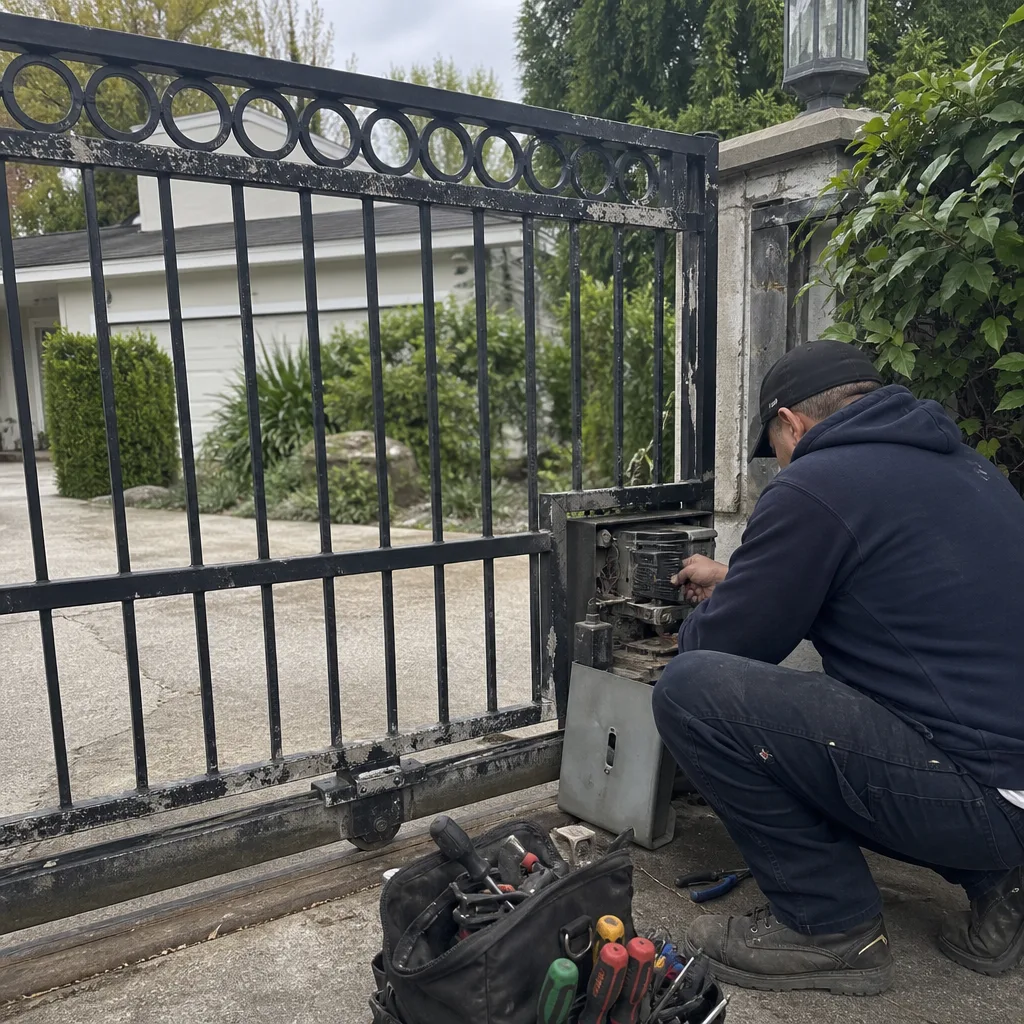 Before
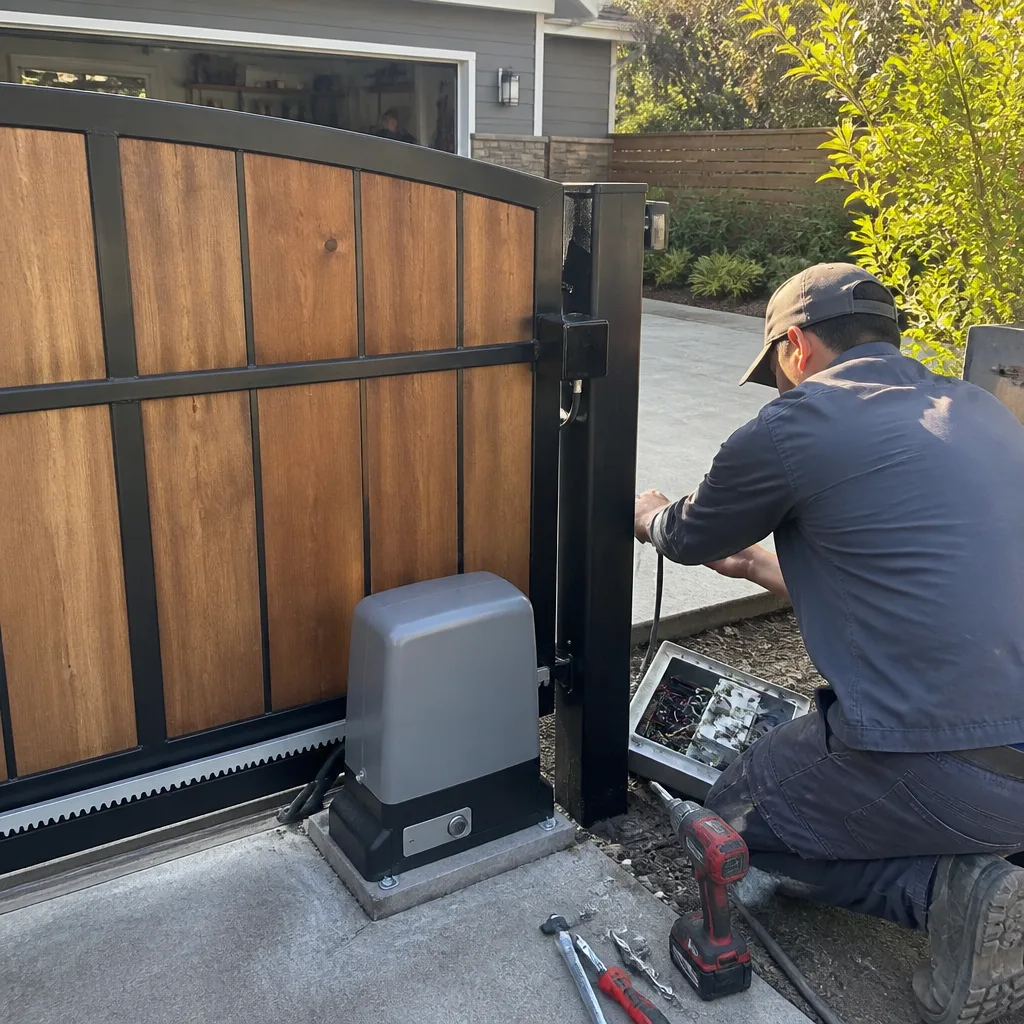 After
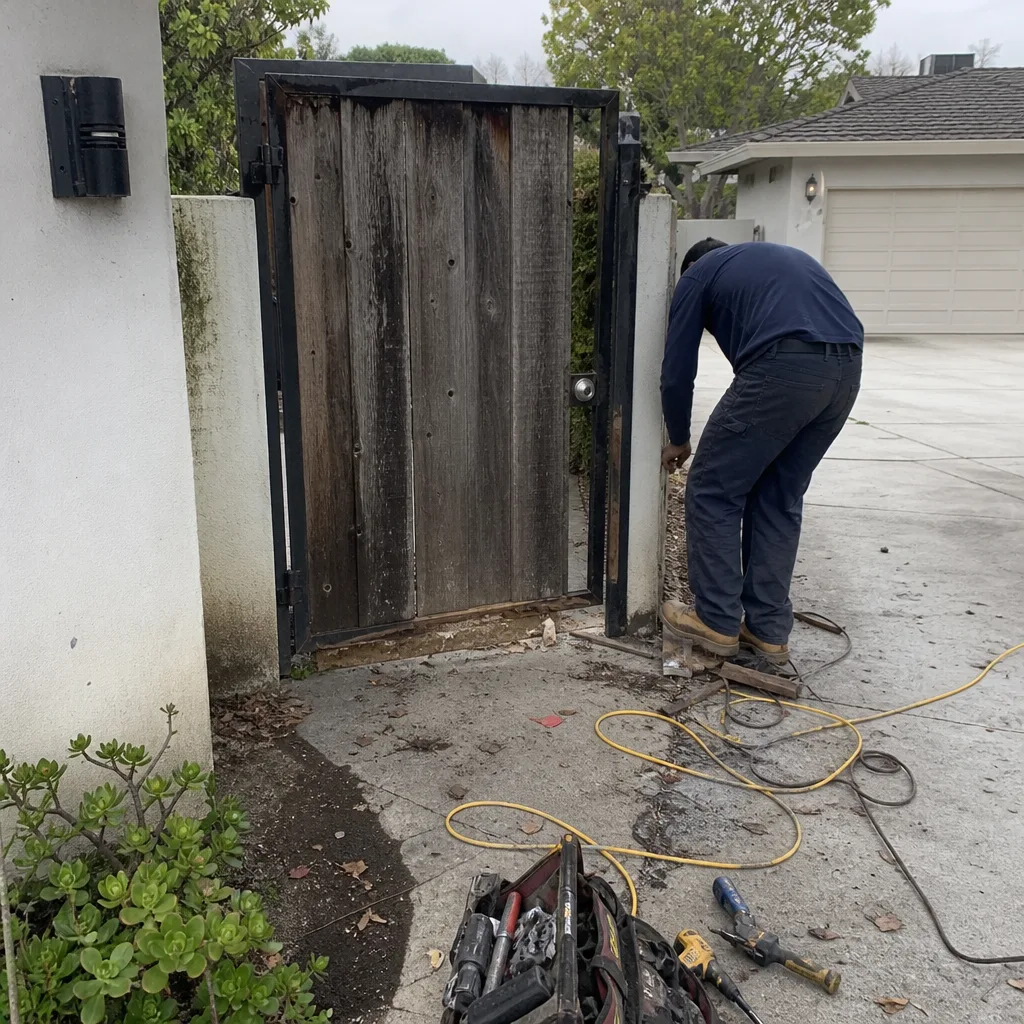 Before
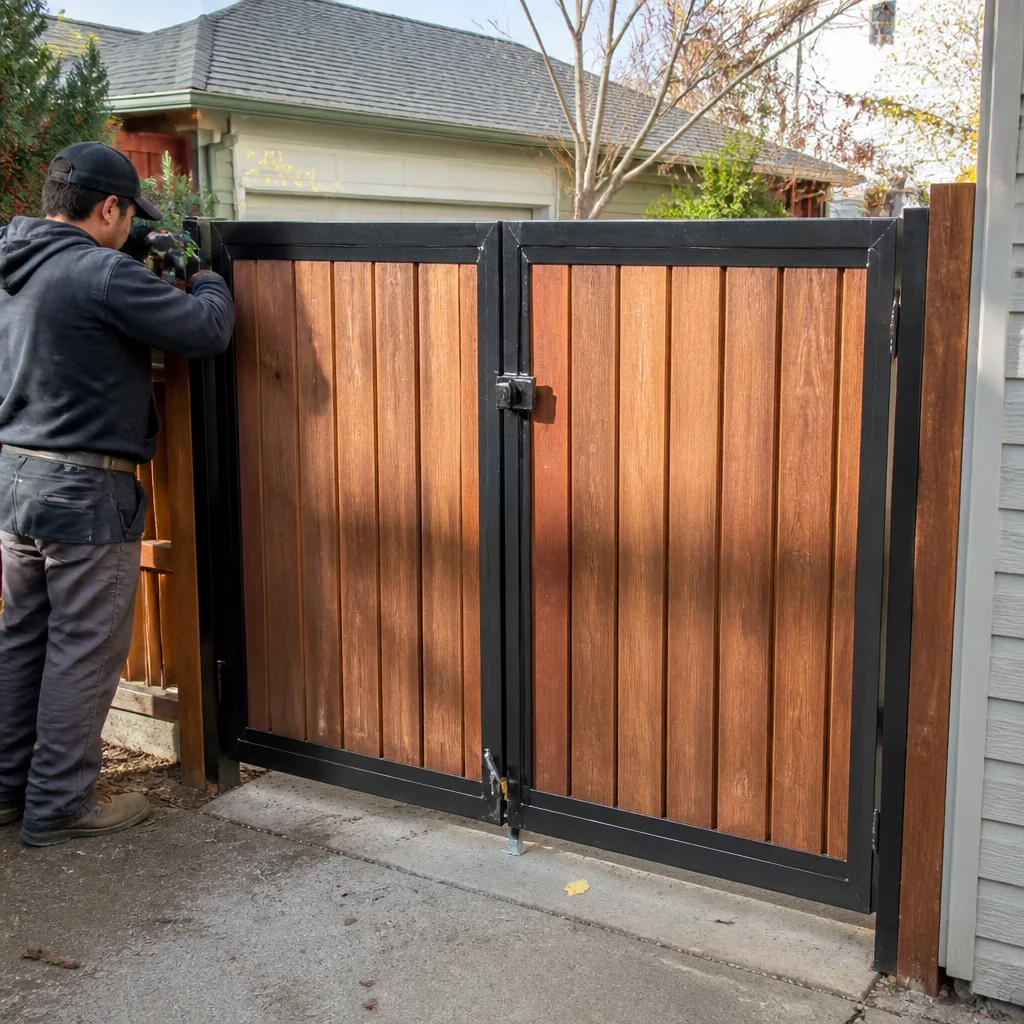 After
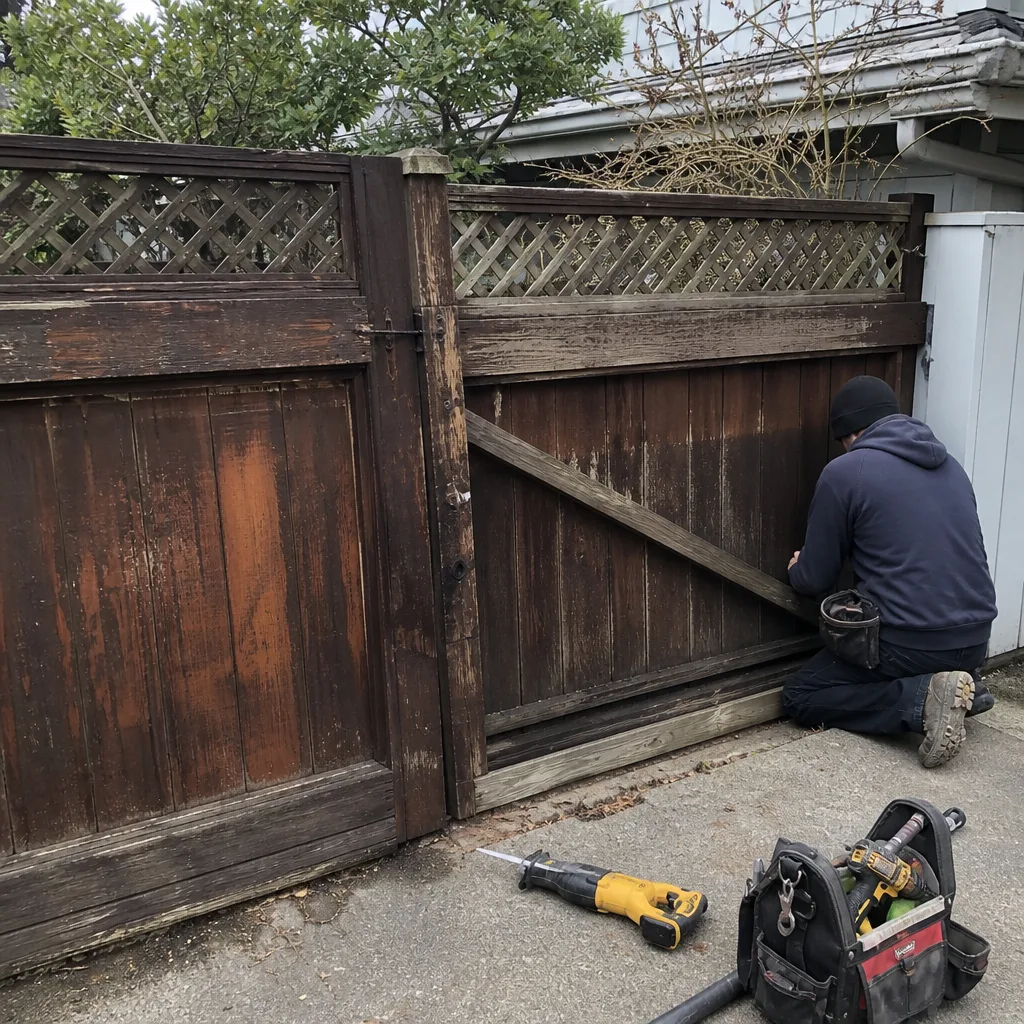 Before
 After