
Last updated November 2, 2026
 Wrought iron
 Wood & steel frame
 Farm & ranch
 Sliding driveway gates
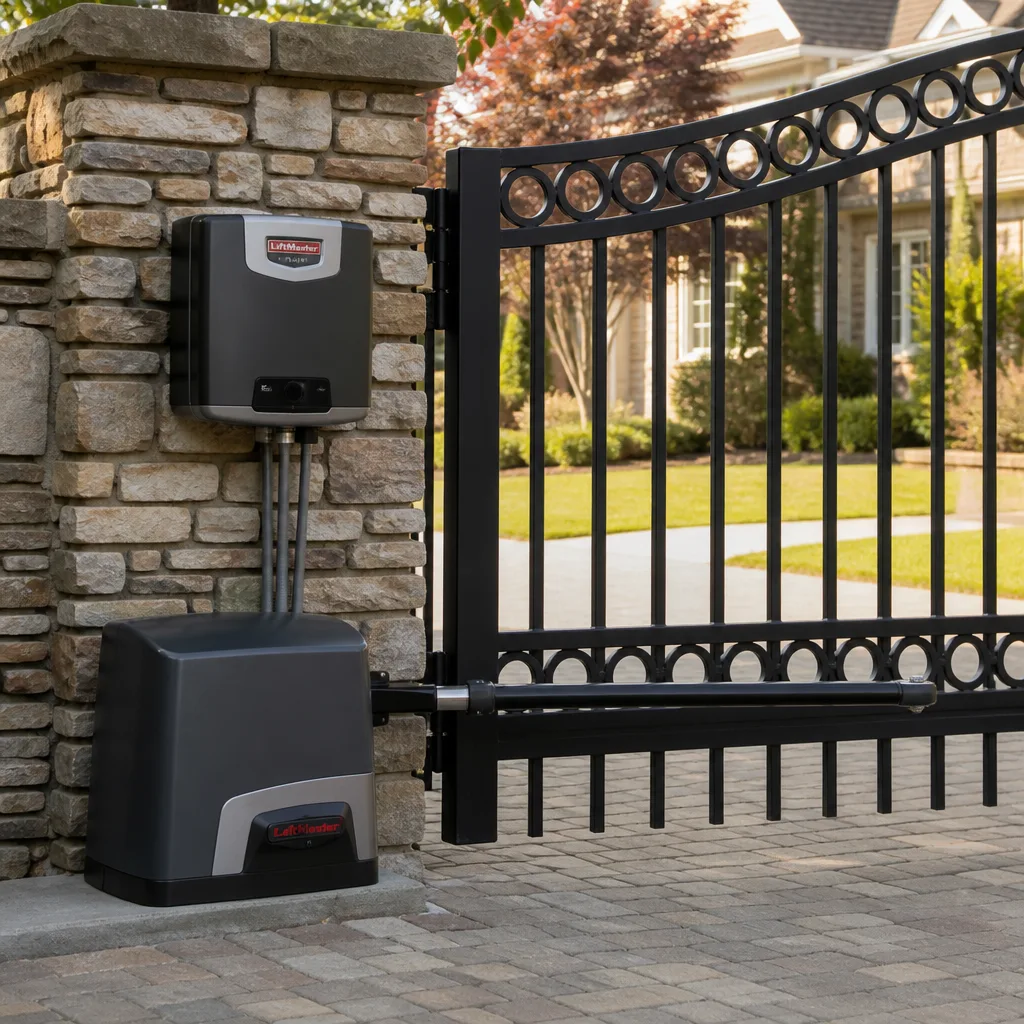 LiftMaster operators
Free on-site gate assessment - hinges, posts, and your LiftMaster or Nice gate operator checked before anything is quoted
The assessment is free and the quote is the invoice.
Get your free estimateHow to Hire a Gate Repair Contractor in San Carlos: A Step-by-Step Guide
Here’s the counterintuitive truth about automated gate repair: California has no licensing category for “gate technician.” The state’s contractor license board covers general building, electrical, and low-voltage work, but nothing that specifically certifies someone to diagnose a FAAC hydraulic operator or a LiftMaster control board. A licensed electrician could legally accept your gate repair job and never have opened an operator housing in his life. This guide walks through the exact steps to separate genuine gate specialists from generalists who are learning on your motor, with San Carlos-specific context on climate, code, and the local contractor landscape. For professional Gate Repair services, working with verified specialists makes all the difference.
Quick Answer
Hiring a gate repair contractor in San Carlos comes down to three verifiable checks: confirm the contractor has brand-specific training on your operator (not just general electrical or handyman experience), verify local references on your exact gate type (swing, slide, or barrier), and get a written diagnosis before any parts are ordered. If a contractor cannot name the brand, model, and likely failure point within the first 15 minutes on site, you’re not paying for expertise, you’re paying for their education. A genuine specialist diagnoses first, quotes a fixed price, and replaces only what’s actually failed.
Styles & brands we work with
- Wrought iron
- Wood & steel frame
- Farm & ranch
- Sliding driveway gates
- LiftMaster operators
Table of Contents
- Why a California License Is Not Enough to Prove Gate Competence
- The Three Credentials That Actually Signal Gate-Specific Competence
- Exact Interview Questions That Reveal Brand Knowledge (and Red-Flag Answers)
- How to Read and Compare Gate Repair Quotes in San Carlos
- Why the Cheapest Bid Statistically Costs the Most Over 24 Months
- Contract Terms to Insist On Before Work Begins
- San Carlos-Specific Considerations: Climate, Code, and Access
- Step-by-Step Hiring Checklist
Why a California License Is Not Enough to Prove Gate Competence
Every contractor in California who does work over $500 must hold a CSLB license. That’s the baseline. But here’s the gap: the CSLB does not issue a “gate repair” classification. Gate work typically falls under C-10 (electrical), C-61/D-28 (door and gate), or a low-voltage classification, depending on the scope. What this means in practice is that a contractor with a C-10 electrical license could show up to your San Carlos home, pull the cover off your FAAC 412 operator, and be looking at the inside for the first time.
Automatic gates sit at an awkward regulatory intersection. They’re mechanical (hinges, wheels, track), electrical (motors, transformers, relays), electronic (control boards, loop detectors, safety sensors), and in some cases hydraulic. A gate specialist working in San Carlos sees the full picture every week: the salt air from the Bay affecting steel components in the flats, the clay soil shifting gate posts on the hillsides, the constant opening and closing cycles that wear out limit switches. Our Seasonal Gate Repair Care for San Carlos: Year-Round Homeowner’s Guide covers how these local conditions shift through the year. A generalist sees a door that happens to be outside.
We’ve walked onto jobs in San Carlos where a previous contractor removed a perfectly good Mighty Mule opener and installed a new one because “the motor burned out.” The actual fault was a $12 limit switch. The customer paid $900 for a replacement they didn’t need. That’s what happens when diagnostics are replaced by guesswork. A brand-trained technician knows what fails on a Mighty Mule MM571W versus a LiftMaster LA400, because each brand has its own weak points. That knowledge exists before the van door opens.
When you’re vetting a contractor in San Carlos, treat the license as the floor, not the ceiling. Ask what sits above it. The answer should be specific and brand-referenced, not vague and reassuring.
The Three Credentials That Actually Signal Gate-Specific Competence
If a license doesn’t separate gate specialists from generalists, what does? In our experience fixing gates across San Carlos, three specific signals indicate a contractor actually knows automated systems rather than just owns a toolbox.
1. Manufacturer Authorization or Documented Brand Training
Brands like LiftMaster, FAAC, BFT, Linear, Viking, Ghost Controls, DoorKing, and Elite all run installer certification programs. A contractor who has completed FAAC training knows the hydraulic pressure settings on a 400-series operator. One who has LiftMaster certification understands the MyQ integration and board diagnostics on an LA500. This is not a piece of paper, it’s the difference between reading an error code and knowing what causes that error code. Ask directly: “Which brands have you completed factory training on?” A real answer names brands. A vague answer names categories (“we work on all brands”) or hides behind general experience.
2. A Low-Voltage or C-10 License for Automated Systems Work
An automated gate is, at its core, a low-voltage control system with a high-torque motor attached. The control board, safety sensors, keypads, and loop detectors all run on low-voltage DC, typically 12-24V. A contractor who understands low-voltage control logic can wire a loop detector correctly, integrate a telephone entry system, and troubleshoot a phantom “gate opens by itself” fault that’s actually a dying sensor. When you see a C-10 or C-7 (low voltage) classification alongside gate-specific experience, that’s the right combination. A general building contractor with no low-voltage classification is a warning sign on automated systems.
3. Verifiable Local References on Your Gate Type
San Carlos has a specific housing mix: mid-century ranchers in White Oaks with original iron gates, newer developments in the hills with slide gates and intercoms, commercial properties along Industrial Road with barrier arms and loop detectors. A contractor who has worked on a slide gate at a San Carlos commercial facility understands the track tolerances and motor sizing involved. One who has replaced swing gate hinges on a 1960s property in the flats knows the post and mounting realities. Ask for references on your specific gate type, in or near San Carlos, and call them. The contractor who hesitates here is one who doesn’t have them.
None of these three credentials appears on a standard license check. They all require you to ask. That’s the point.
Exact Interview Questions That Reveal Brand Knowledge (and Red-Flag Answers)
Hiring a gate repair contractor in San Carlos is an interview, not a formality. The right questions expose technical depth immediately. Here are the specific questions to ask, the answer signals to listen for, and the red flags that indicate a generalist.
Questions to Ask and What Good Answers Sound Like
“What brand and model is my gate operator, and what are the most common failure points on it?”
A specialist answers this without hesitation. If you tell them you have a FAAC 412, they should mention the hydraulic pump, the solenoid valves, and the pressure switch as known components. If you have a LiftMaster LA400, they should reference the control board, the travel limit assembly, and the gear train. A generalist says something like “those are all pretty similar” or “I’d have to take a look.” You’re not asking them to diagnose sight-unseen. You’re asking them to prove they’ve seen this machine before.
“On a [your operator brand], what’s the difference between a control board fault and a sensor fault, and how do you tell them apart?”
A brand-trained technician describes the diagnostic sequence: reading the board’s LED error codes, testing the sensor loop with a multimeter, checking voltage at the input terminals, and isolating the fault by disconnecting components one at a time. A generalist says “the board’s probably bad” and reaches for a replacement quote. Boards get replaced when sensors fail constantly, because replacing a board is a bigger job and the fault “goes away” until the sensor degrades further. That’s a $500 repair you didn’t need followed by the $200 repair you actually needed.
“Will you give me a written diagnosis before ordering any parts?”
A real specialist says yes without flinching. A written diagnosis includes: the specific fault observed, the diagnostic steps performed, the component(s) identified as failed, and the recommended repair. It’s a document you can take to a second opinion. A contractor who refuses a written diagnosis or insists on “just trusting them” is protecting their parts markup, not your gate.
“What safety sensor requirements apply to my gate under UL 325, and is my system compliant?”
UL 325 is the safety standard for automated gates. It mandates entrapment protection: photo eyes, contact edges, or both, depending on gate configuration. A qualified contractor knows UL 325 and checks compliance on every automated gate they touch. A generalist gives you a blank look and says “what’s UL 325?” That’s a disqualifier on an automated system, because a non-compliant gate is a liability you carry as the property owner.
Red-Flag Vague Answers That Expose Generalists
- “We work on all major brands” – without naming any. If they can’t name LiftMaster, FAAC, or Mighty Mule spontaneously, they don’t work on them.
- “It’s probably the motor” – pronounced without diagnostics. Motors fail, but they fail less often than limit switches, sensors, batteries, and boards. “Probably” is not a diagnosis.
- “I’ll know more when I get in there” – true of any repair, but a specialist can tell you the most likely fault based on symptoms before opening the housing.
- “Same thing as a garage door opener” – it is not. Gate operators face weather exposure, longer duty cycles, and entrapment safety requirements that garage openers don’t. Any contractor who equates them is telling you they don’t understand the difference.
- “Let me check with my supplier” – when asked for a specific recommendation. A technician who knows the equipment can recommend a course of action from experience, not from a parts catalog conversation.
How to Read and Compare Gate Repair Quotes in San Carlos
Most homeowners in San Carlos compare quotes by looking at the bottom line. That’s backwards. The total price is the last thing that matters, because two quotes for the same gate repair can differ by $800 and both be legitimate, or differ by $40 and be worlds apart. Here’s what actually separates a real quote from a placeholder.
Step 1: Look for a specific failure description.
A real quote says: “Replace failed FAAC 412 control board (error code 7 – motor relay failure). Includes board removal, installation, dip switch configuration, and full operational test.” A placeholder says: “Repair gate opener.” The first quote tells you what’s wrong and what’s being done. The second tells you nothing except that someone plans to do something for a price.
Step 2: Check for parts specificity.
Does the quote name the specific part and brand? “Replace Mighty Mule MM371 limit switch” is a real quote. “Replace gate part” is not. Parts specificity matters for two reasons: it proves the contractor diagnosed a specific fault, and it lets you verify the part cost independently. A contractor who hides part information is protecting a markup, not your interest.
Step 3: Look for labor broken out.
Labor should be itemized or at least separated from parts. This is not so you can haggle, but so you can compare scope. Two quotes might both say “gate repair,” but one includes four hours of trouble-shooting, parts installation, and adjustment, while the other includes one hour and a “revisit if needed.” The four-hour quote might be the better deal if the fault actually takes four hours to diagnose and fix properly.
Step 4: Evaluate the warranty.
A quote that includes a written parts warranty and labor warranty, even 90 days, signals a contractor who expects the repair to hold. A quote with no warranty language is a contractor who expects you to call them back and pay again when it fails.
Typical San Carlos Gate Repair Pricing Ranges
While every gate is different, here are realistic price ranges for common repairs in the San Carlos market, based on what we see across residential and light commercial properties:
| Repair Type | Typical Range | Notes |
|---|---|---|
| Limit switch replacement | $180 – $340 | Common on Mighty Mule and LiftMaster swing gates; usually same visit |
| Control board replacement | $350 – $750 | Brand-dependent; FAAC and BFT boards cost more than entry-level units |
| Safety sensor / photo eye replacement | $200 – $420 | Includes post-mounted and retrofitted edge sensors |
| Gate hinge and post repair | $400 – $900 | Steel gate re-hanging or post stabilization in shifting soil |
| Motor replacement (complete operator) | $900 – $2,500 | Range from Mighty Mule residential to commercial FAAC hydraulic |
| Full operator replacement (parts + labor + programming) | $1,500 – $4,000 | Includes removal, mounting, wiring, safety sensor integration, and programming |
These ranges assume a licensed contractor working with proper parts. A quote significantly below these numbers is not a bargain. It’s a signal that something is being skipped: wiring, programming, safety sensor integration, or a proper operational test. A quote above these ranges should come with an explanation: brand premium, access difficulty, or commercial duty cycle. The price you agree to should be fixed before any work starts, with no open-ended “time and materials” language. If a contractor won’t commit to a number, get another contractor.
For context on the full scope of residential and commercial gate services available in the area, see our Gate Repair in San Carlos page.
Why the Cheapest Bid Statistically Costs the Most Over 24 Months
Here’s a pattern we see repeatedly in San Carlos: a homeowner takes the lowest bid, the repair works for three months, then fails again. The original contractor is unavailable or unresponsive. The second repair costs more because the first one “fixed” the wrong thing or introduced a new problem. Over 24 months, that $300 “savings” has turned into $1,400 in extra repairs, and the gate was unreliable the whole time.
How does this play out mechanically? A low bid on a gate repair usually cuts one of three things: diagnostic time, parts quality, or testing.
Cut diagnostic time. A proper diagnosis on an intermittent gate fault can take 60 to 90 minutes. It involves observing the gate under load, testing voltage at the control board, checking sensor alignment, and cycling the operator repeatedly to reproduce the fault. A contractor bidding $75 for the visit cannot afford 90 minutes of diagnostics. So they guess, replace the most visible component, collect their money, and leave. The intermittent fault remains, now wearing out the new component too.
Cut parts quality. A genuine FAAC or LiftMaster replacement board costs what it costs. A no-name aftermarket board from an online marketplace costs half as much and fails twice as fast. A contractor bidding low enough to win the job often needs aftermarket parts to maintain margin. The customer’s savings disappears when the aftermarket board fails at month 14 and they pay full price for the real part plus another labor charge.
Cut testing. A proper repair ends with operational testing: multiple open/close cycles, safety sensor obstruction tests, force setting adjustment, and sometimes a simulated power outage to verify battery backup. This takes time. A low-bid contractor might do one open and one close, call it good, and drive off while the gear train whines from a misadjusted limit. The next failure is already scheduled, it just hasn’t happened yet.
The honest contractor in San Carlos charges enough to diagnose properly, use genuine parts, and test thoroughly. That costs more on day one, and less over two years. This is not a theory; it’s the difference between a gate that works for five years and one that creates a service call every four months.
Contract Terms to Insist On Before Work Begins
Verbal agreements on gate repair are worth the paper they’re printed on. If a contractor won’t put terms in writing, you have your answer. Here are the specific terms that should be in any gate repair contract in San Carlos.
1. Written diagnosis. The contract should state what was found and what the repair plan is. Not “inspect and repair.” Specific: “Replace FAAC 412 hydraulic solenoid valve, part #XXXX, due to observed leak at fitting.” This is your record if the repair fails and the contractor claims a different fault was present.
2. Parts warranty. The contract should name the parts installed and state the warranty period, typically 90 days to 1 year for electronic components. This should be from the manufacturer, passed through to you, and in writing.
3. Labor warranty. If the part fails under warranty, who pays for the labor to replace it? A contractor who warrants their labor for 90 days or more is standing behind their work. A contractor who says “parts warranty only” is telling you that if their installation fails, you pay again for the labor.
4. Fixed price commitment. The contract should state the total cost including parts, labor, and any service fee. No “plus additional time if needed.” No “price varies depending on what we find.” The diagnosis was the discovery phase. The repair is the execution phase. Execution should be a fixed number.
5. Scope of work. What exactly is being done? Which components are being replaced? Will the gate be adjusted after installation? Will safety sensors be checked and tested? Will the contractor verify UL 325 compliance? A one-line scope (“fix gate”) is not a scope.
6. Payment terms. When is payment due? A reasonable structure is a deposit for parts (if expensive and special-ordered) and the balance on completion. Full payment upfront for a repair is a risk you should not take, because it removes the contractor’s incentive to complete the job correctly. For more guides & resources on protecting yourself during home repairs, see our blog.
San Carlos-Specific Considerations: Climate, Code, and Access
San Carlos has its own personality when it comes to gate repair. The same gate that runs flawlessly in Redwood City or Belmont can behave differently here, and a contractor who understands the local context will diagnose faster and repair more durably.
Climate wear on gate components. San Carlos sits in a microclimate zone where morning fog from the Bay gives way to afternoon sun, often jumping 20 degrees in a few hours. That thermal cycling stresses solder joints on control boards and accelerates corrosion on exposed wiring. In the flats near Holly and Brittan, moisture lingers longer. On the hillsides, wind gusts off the coastal range add mechanical stress to swing gates. A steel gate hinge that lasts decades in a dry inland climate can fail in 8-10 years here. When we diagnose in San Carlos, we look for corrosion patterns that a contractor from Hayward or San Jose might not anticipate.
Soil movement and gate posts. The hillside neighborhoods of San Carlos, particularly around Crestview and Devonshire Canyon, sit on expandable clay soils. Gate posts set in that soil shift with seasonal moisture changes. A swing gate that drags on the latch in summer might hang true in winter. A contractor who understands this won’t just adjust the hinge; they’ll check the post footing and recommend stabilization if needed. A contractor who doesn’t will keep adjusting the same gate every season and charging for it.
Access and property types. San Carlos has a mix of flat residential streets, hillside roads with limited pull-off space, and commercial properties with tight drive aisles. A slide gate at a commercial facility off Industrial Road needs a different repair approach than a residential swing gate on a quiet cul-de-sac. The contractor needs appropriate equipment for the site, and the quote should reflect any access complexity. If a contractor quotes sight-unseen without asking about access, they’re not planning the job seriously.
For automated systems specifically, the repair landscape gets more technical. See Electric Gate Repair in San Carlos for a deep dive into motors, control boards, and safety systems.
Step-by-Step Hiring Checklist
If you’re hiring a gate repair contractor in San Carlos this week, here is the process, compressed into a checklist.
- Gather your gate’s information. Note the brand name (LiftMaster, FAAC, Mighty Mule, BFT, or other), approximate age, and what the gate is doing wrong. Specific symptoms (“opens but won’t close,” “beeps but won’t move,” “moves slowly then stops”) help the contractor diagnose over the phone.
- Call two or three contractors. Ask the interview questions from this guide. Pay attention to who asks you questions in return. A good contractor wants to know the brand, age, and symptoms before they arrive.
- Verify licenses and references. Check the CSLB website for license status and classification. Ask for references in San Carlos on your gate type. Call them.
- Get everything in writing. The diagnosis, the proposed repair, the parts, the labor, the warranty, the price. All of it. On paper or in an email.
- Agree on the fixed price before work starts. If you are not comfortable with the price, say so before they start turning wrenches. A reputable contractor prices upfront.
- Be present for the repair if possible. Watch what they do. Ask questions. A confident specialist welcomes interested customers. Evasive behavior is a signal.
- Test the gate thoroughly before they leave. Open and close it several times. Test the safety sensors by blocking the gate’s path. Listen for grinding, clicking, or straining. If something seems off, say so before they drive away.
- Keep the paperwork. The diagnosis, the invoice, the warranty. In a year, when you need the board serial number or the original fault code, you’ll be glad you have it.
Common Mistakes to Avoid
- Assuming any licensed contractor can fix an automated gate. Licenses cover categories, not brands. A C-10 electrical license does not mean LiftMaster board diagnostics. Verify brand training specifically.
- Hiring on price alone. The cheapest quote on a gate repair in San Carlos often excludes diagnostic time, uses aftermarket parts, or skips testing. The savings disappear on the second repair.
- Accepting a verbal diagnosis. If it’s not in writing, it didn’t happen. A written diagnosis is the difference between accountability and a “new problem” on the next visit.
- Ignoring safety sensor compliance. UL 325 exists to prevent injuries. A contractor who doesn’t check for compliance on an automated gate is leaving you with liability and an unsafe installation.
- Choosing a generalist because they’re “close by.” Proximity is nice, but competence is better. A 25-minute drive for a brand-trained specialist beats a 5-minute drive for someone learning on your operator.
- Deferring maintenance to save money. A gate that receives a $150 annual service (lubrication, limit adjustment, sensor check, hinge inspection) lasts years longer than one that runs until failure. Deferred maintenance is the most expensive gate repair there is.
- Letting a contractor “upgrade” you without a written explanation. If the recommendation is to replace rather than repair, ask for the written diagnosis that justifies replacement. “It’s old” is not a diagnosis. “The gear train is worn beyond adjustment and replacement parts are discontinued” is a diagnosis.
See the difference
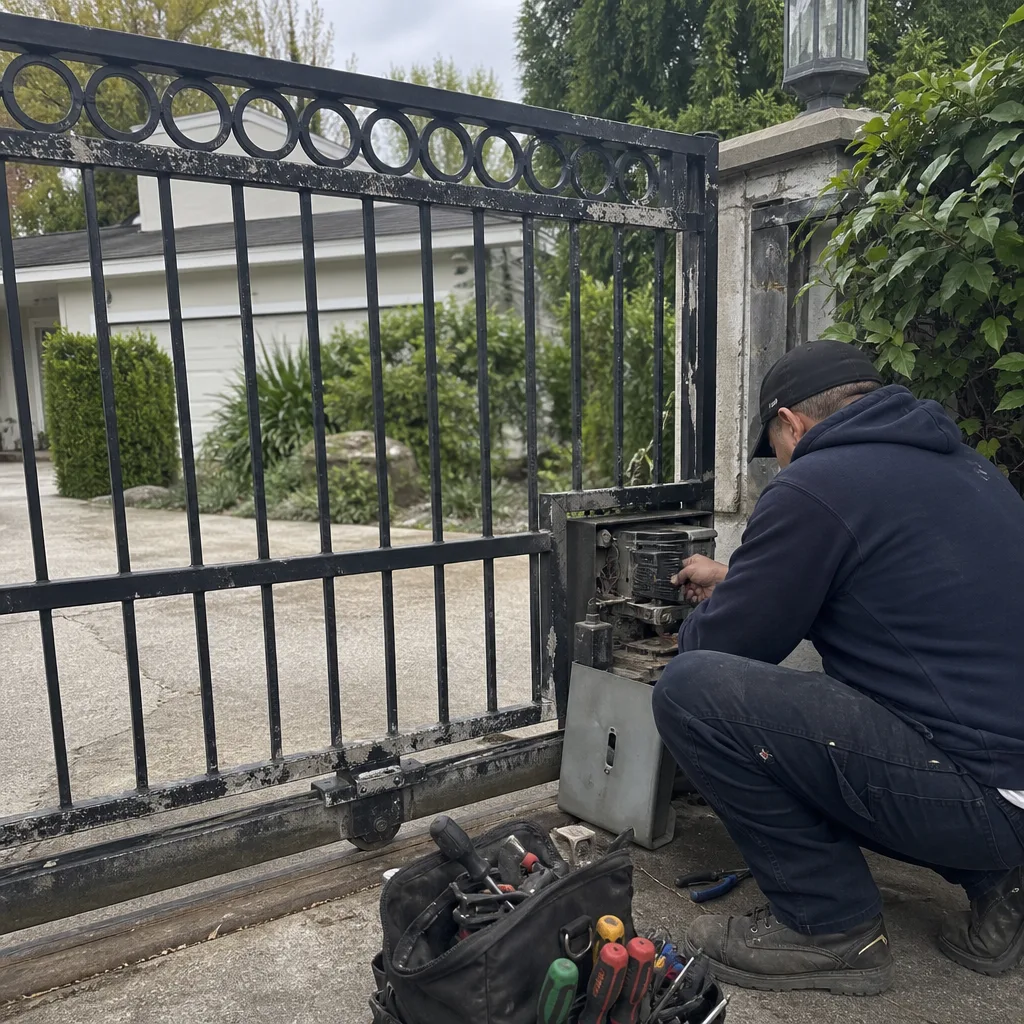 Before
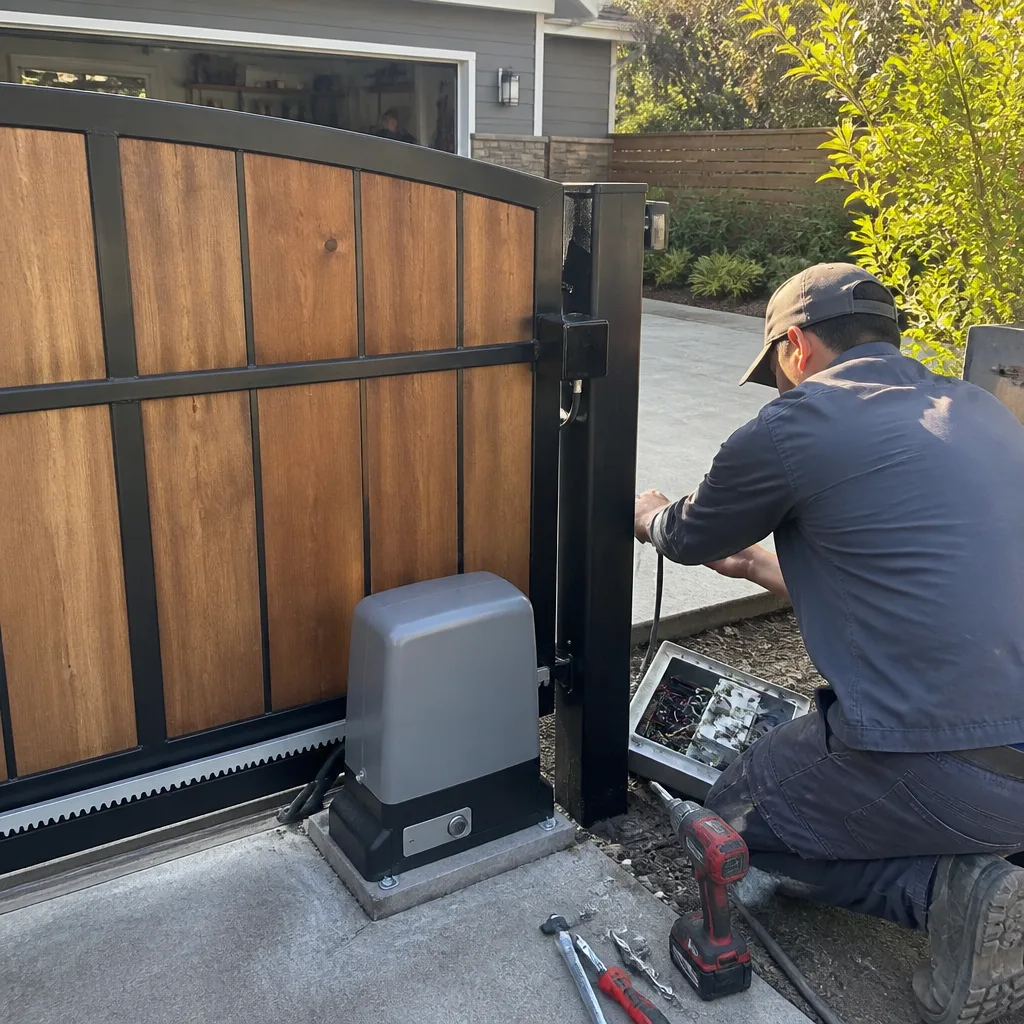 After
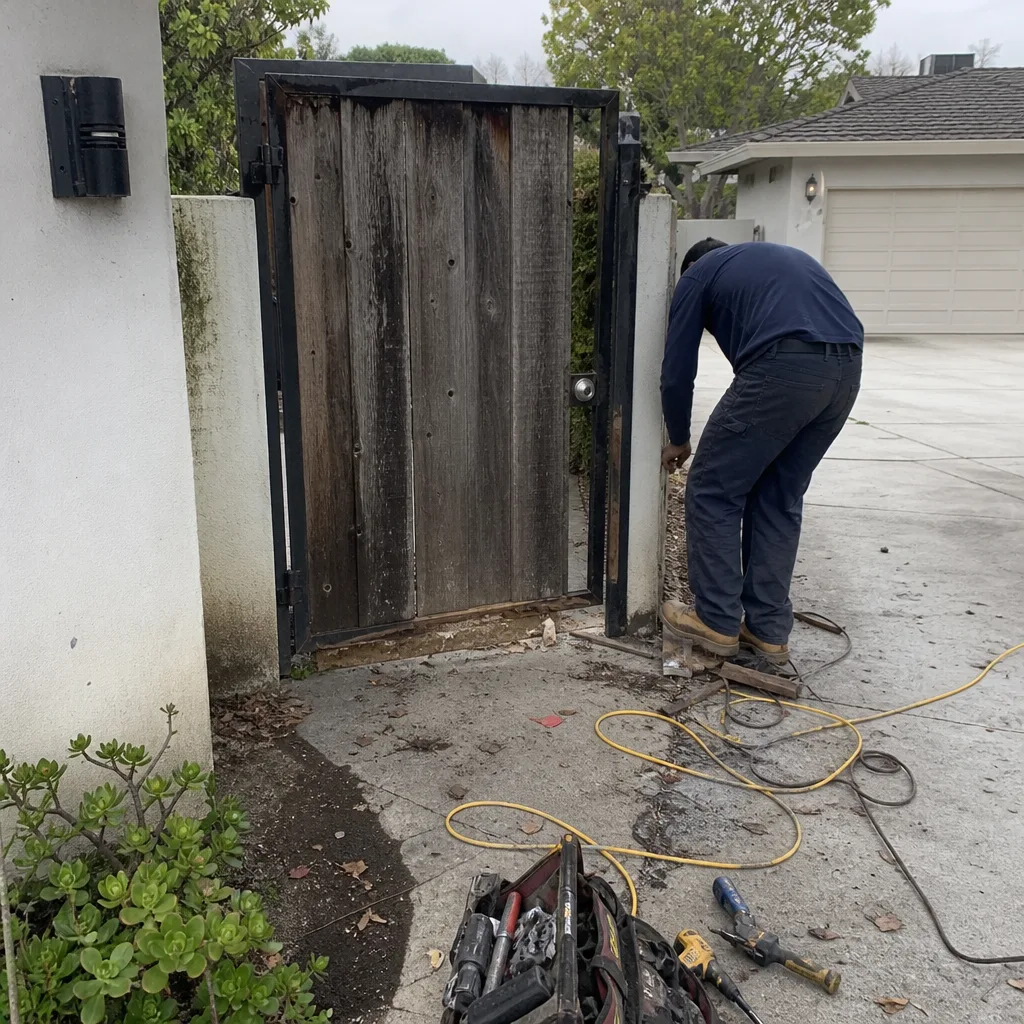 Before
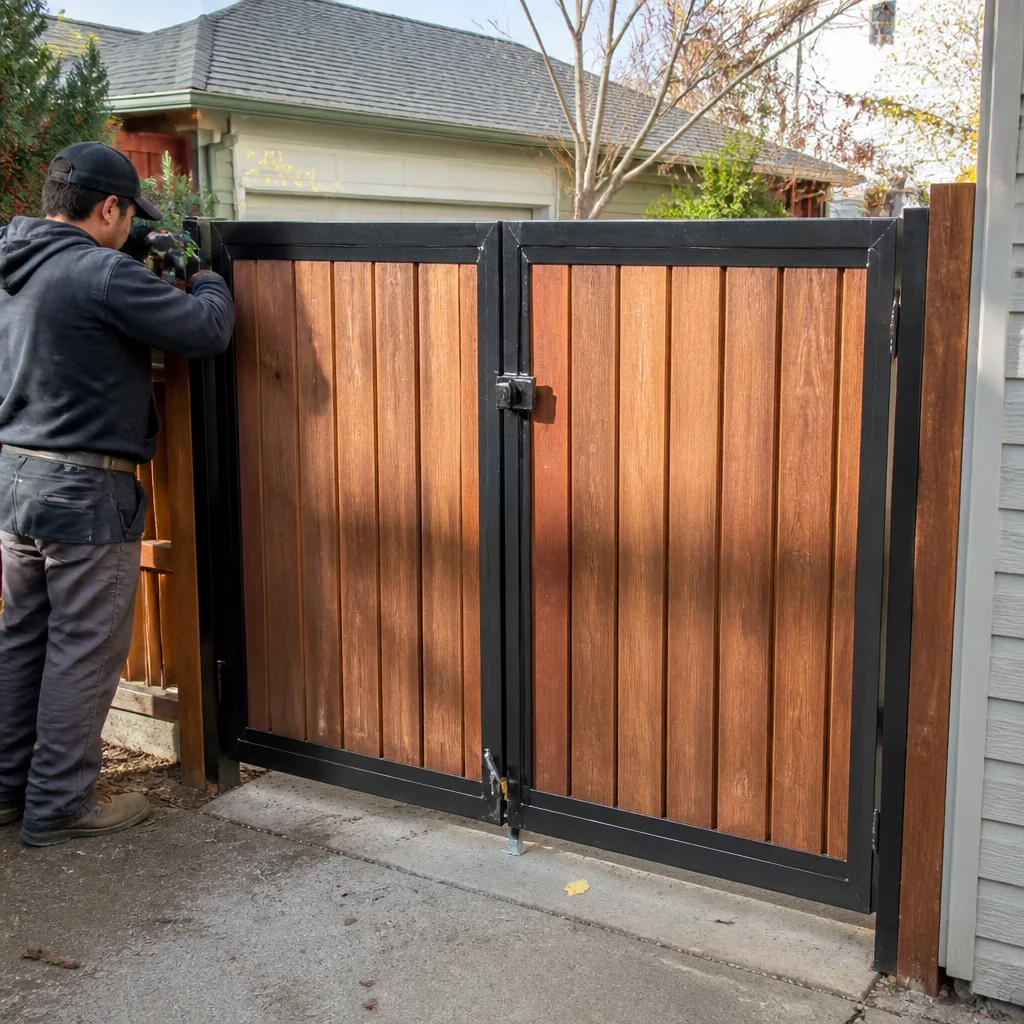 After
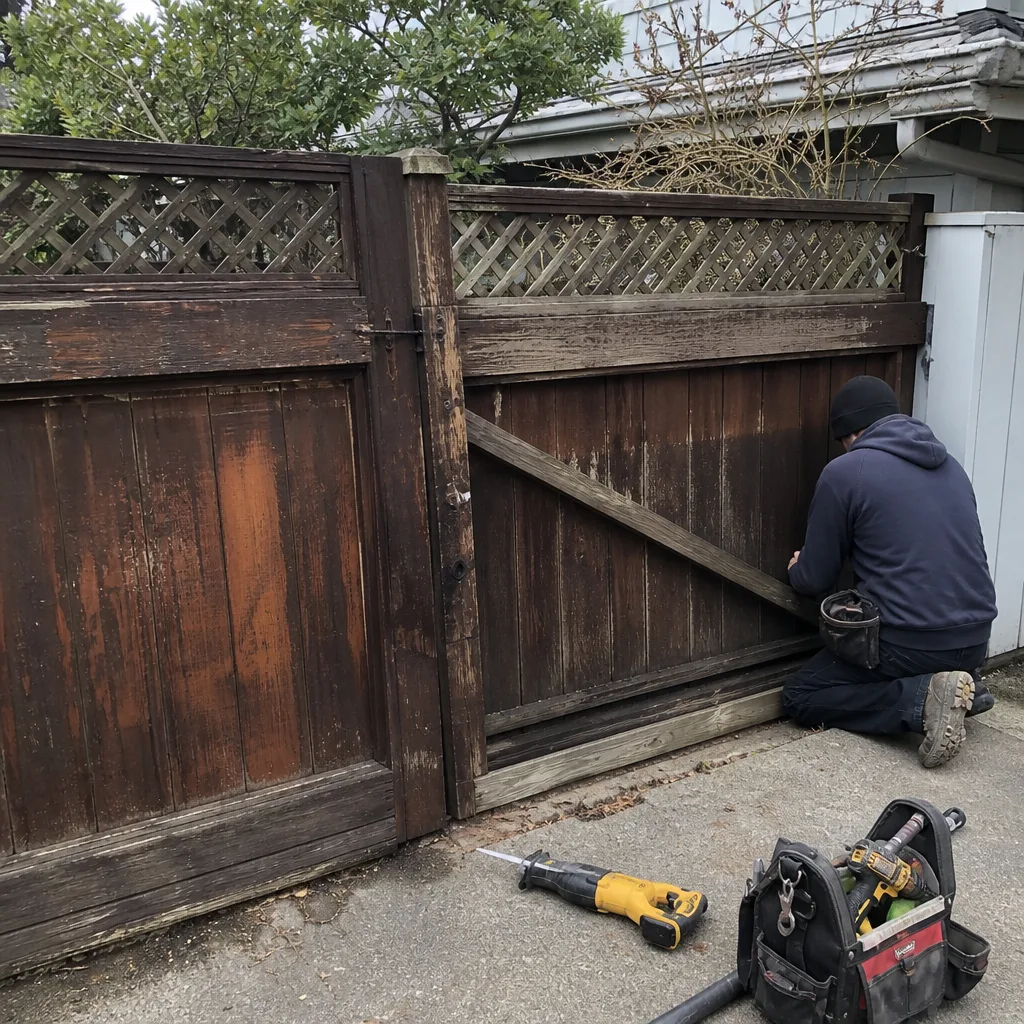 Before
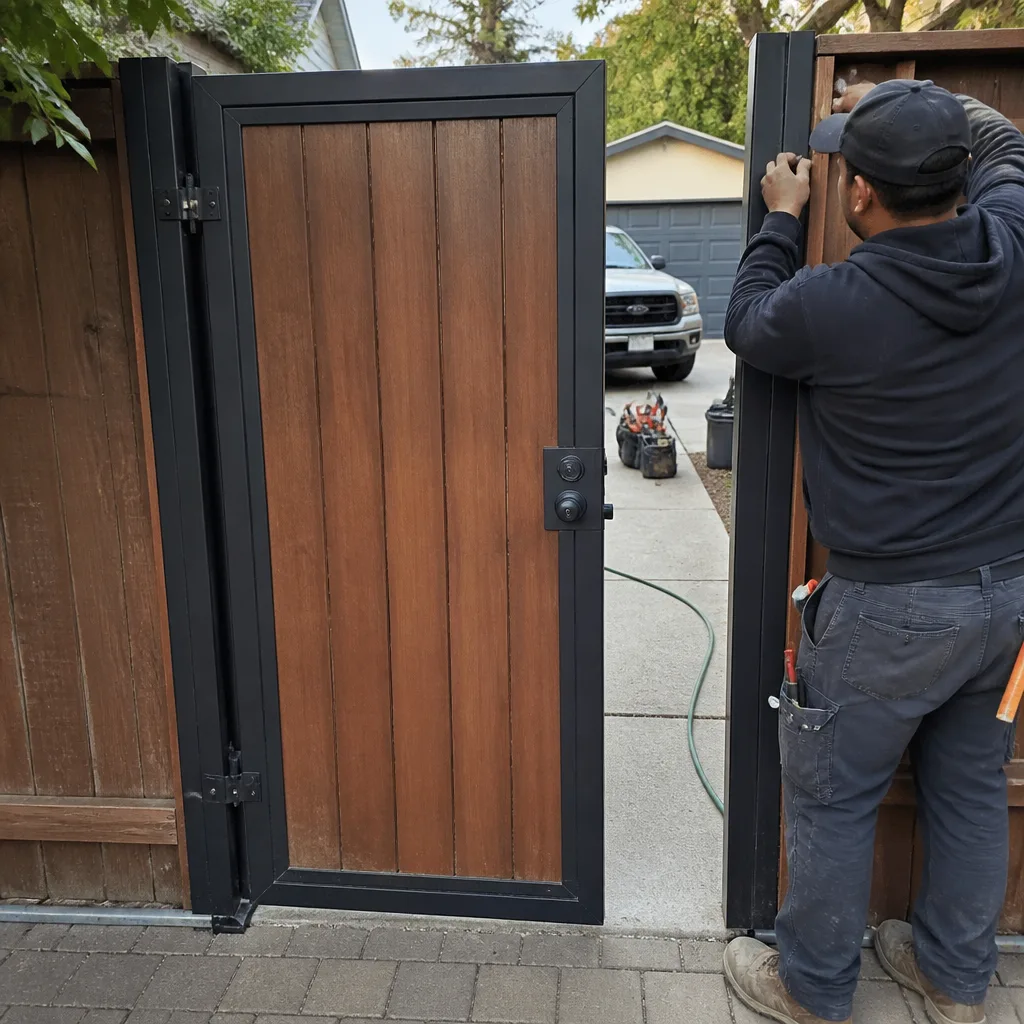 After
When to Call a Professional
Some gate issues are safe to inspect yourself: checking for obvious obstructions in the track, confirming the gate has power, or tightening a loose hinge bolt. But most automated gate failures need a trained technician, because the systems combine high-torque motors, energized wiring, and safety-critical sensors. If your gate is making grinding or popping sounds, moving erratically, reversing for no reason, or refusing to respond to remotes or keypads, it is time to call someone who specializes in these systems. Attempting board-level diagnosis or motor work without training is how small problems become expensive replacements. Gate Repair San Carlos offers free estimates in San Carlos, call (855) 395-1573.
Frequently Asked Questions
Ask four things: which brands they have completed factory training on, whether they hold a low-voltage or C-10 license for automated systems, which San Carlos references they can provide for your specific gate type, and whether they’ll give you a written diagnosis before ordering parts. Qualified contractors answer all four without hesitation. Vague answers to any of these questions indicate a generalist.
Gate repair in San Carlos typically ranges from $180 for a simple limit switch replacement to $750 or more for a control board fault on a premium operator like FAAC or BFT. Full operator replacement runs $1,500 to $4,000 depending on brand and duty cycle. Always insist on a written fixed-price quote before work starts, and call (855) 395-1573 for an exact estimate, free of charge.
Most gate repair companies in San Carlos, including Gate Repair San Carlos, prioritize emergency calls for gates that are stuck open, stuck closed, or creating a security risk. Response time depends on call volume and time of day, but an automated gate that is not functioning is treated as urgent. Call (855) 395-1573 and describe the symptoms, and we’ll tell you honestly what the timeline looks like.
A gate repair specialist has brand-specific training on automated operators (LiftMaster, FAAC, Mighty Mule, BFT, and others), carries gate-specific diagnostic tools and parts, and understands UL 325 safety compliance. A general handyman replaces hinges and paints frames, but typically cannot diagnose a control board fault, wire a loop detector, or program an access control system. Automated gates need the specialist.
The answer depends on the diagnosis. If the failure is a limit switch, sensor, or control board on an operator that is less than 10 years old and otherwise functioning, repair is usually the right call. If the gear train is worn, the motor is failing, and the operator is discontinued or nearing end of life, replacement may be more economical. A written diagnosis should tell you which path is right. For new automation options, see Gate Installation in San Carlos.
Yes. The thermal cycling from morning fog to afternoon sun stresses control board solders and accelerates corrosion on exposed wiring. Hillside clay soils shift gate posts seasonally. Gates in San Carlos require slightly more frequent maintenance than the same equipment in a drier inland climate, which is why annual service visits matter here. A local contractor who understands these conditions will diagnose and repair accordingly.
The Bottom Line
Hiring a gate repair contractor in San Carlos is about verifying specialization, not just licensing. California’s licensing system won’t filter out generalists for you. You have to ask the questions: which brands they’re trained on, whether they’ll provide a written diagnosis, what warranty they put in writing, and what their San Carlos references say. The cheapest quote often becomes the most expensive repair over two years. The right contractor identifies the exact fault, fixes it with the correct part, tests it thoroughly, and warrants the work. That’s what you’re paying for, and it’s what protects your gate, your security, and your budget over the long run. See Gate Repair San Carlos home for a full overview of our services and service area.
Written by the team at Gate Repair San Carlos, serving San Carlos since 2017.